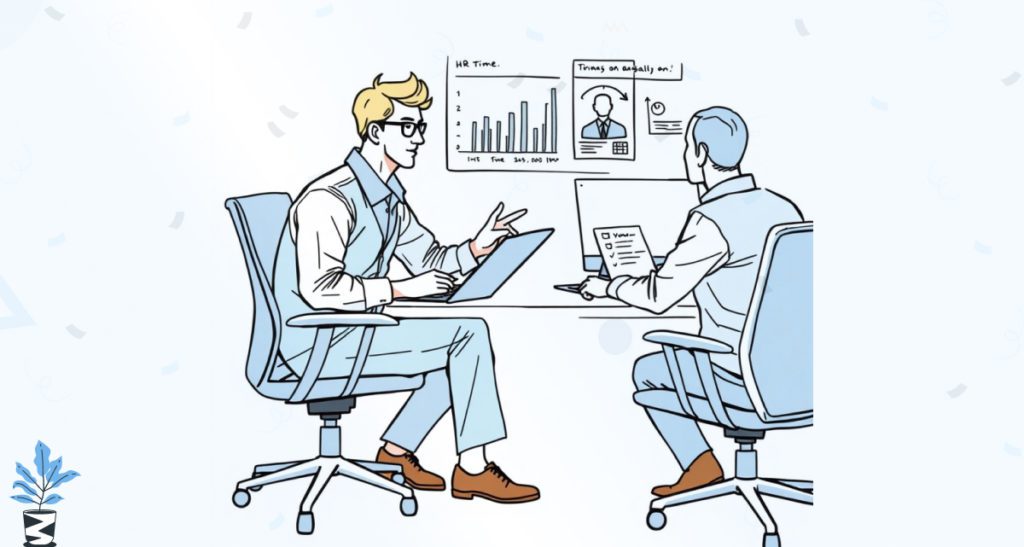
HR leaders today are under constant pressure to justify every hiring decision, retention strategy, and workforce investment with measurable outcomes. Gut instinct is no longer enough. Boards expect predictive insights. CEOs expect measurable ROI. Employees expect fairness and transparency.
This is where AI Helps HR Make Data-Driven Decisions in a transformative way. By turning workforce data into predictive insights, artificial intelligence enables CHROs and Talent Heads to move from reactive management to strategic leadership backed by analytics, not assumptions.
TL;DR
- AI Helps HR Make Data-Driven Decisions by analyzing workforce data in real time.
- Predictive analytics improves hiring quality, attrition control, and performance management.
- AI reduces bias and increases accuracy in talent decisions.
- Workforce dashboards provide leadership with actionable insights.
- Integrated HRMS platforms make AI-driven decision-making scalable and secure.

Looking for the Best Online HR Software ? Check out the Best Online HR Software.
Why Data-Driven HR Is No Longer Optional
Traditionally, HR decisions relied heavily on experience and intuition. While experience still matters, modern workforce complexity demands deeper analysis. Hybrid teams, skill shortages, compliance regulations, and rising attrition rates require measurable strategy.
According to global HR research, organizations using people analytics are significantly more likely to outperform competitors in talent retention and productivity. The reason is simple: data reduces uncertainty.
When HR relies on spreadsheets and fragmented reports, decisions become delayed and inconsistent. However, AI-powered systems aggregate data across recruitment, attendance, payroll, engagement, and performance delivering real-time intelligence.
By implementing systems where AI Helps HR Make Data-Driven Decisions, organizations gain clarity on:
- Which hiring channels produce top performers
- Which departments face burnout risk
- Which compensation patterns impact attrition
- Which skills gaps threaten business growth
Pro Tip: Start by defining 5–7 executive-level HR metrics (attrition rate, time-to-hire, engagement score, cost-per-hire, productivity index) and align AI dashboards around them.
Core Areas Where AI Enhances HR Decision-Making
1. Smarter Talent Acquisition Decisions
Recruitment generates massive amounts of data resumes, interview feedback, skill assessments, and offer acceptance trends. AI analyzes these inputs to identify patterns that predict high performance.
For example, AI-powered recruitment analytics can reveal which sourcing platforms yield employees with longer tenure or stronger performance ratings. Additionally, predictive models assess candidate-job fit beyond keyword matching.
This shifts hiring from subjective judgment to structured evaluation. It also reduces unconscious bias by standardizing screening processes.
Moreover, AI-driven shortlisting reduces time-to-hire without compromising quality enabling HR to balance speed and precision.
2. Predicting and Reducing Employee Attrition
Employee turnover is expensive and disruptive. Instead of reacting to resignation letters, AI analyzes leading indicators declining engagement, attendance irregularities, stagnant compensation, missed promotions, or reduced learning participation.
By detecting patterns across departments, AI highlights attrition hotspots. Leaders can then introduce targeted retention initiatives such as career development conversations, workload redistribution, or compensation reviews.
When AI Helps HR Make Data-Driven Decisions, attrition management becomes proactive rather than reactive protecting both revenue and employer brand.
3. Performance and Productivity Optimization
Traditional annual appraisals offer limited strategic value. AI enhances performance management by analyzing real-time performance trends, goal completion rates, peer feedback patterns, and productivity metrics.
Predictive analytics can identify high performers early and detect skill gaps before they affect outcomes. Additionally, AI helps correlate training participation with productivity improvement ensuring learning investments deliver ROI.
Instead of relying on subjective evaluations, HR leaders gain measurable performance indicators aligned with organizational objectives.
4. Workforce Planning and Skills Forecasting
Strategic workforce planning requires anticipating future skill demands. AI examines project pipelines, market expansion plans, and internal skill inventories to forecast future talent needs.
For example, AI can highlight departments lacking digital skills or identify employees ready for leadership roles based on competency trends. This supports succession planning and internal mobility strategies.
As a result, HR transitions from transactional hiring to long-term workforce architecture design.
Pro Tip: Combine AI-driven skills mapping with internal mobility programs to reduce external hiring costs.
5. Enhancing Employee Engagement Insights
Employee engagement surveys often generate static reports. AI elevates this process by performing sentiment analysis on feedback, identifying recurring themes, and linking engagement scores with performance or turnover trends.
If certain teams consistently show declining engagement, leadership can investigate managerial practices or workload distribution. AI helps prioritize interventions where impact is highest.
This transforms engagement from a survey exercise into a measurable business driver.

The Technology Behind AI-Driven HR Decisions
To understand how AI Helps HR Make Data-Driven Decisions, it’s important to examine the core technologies enabling it.
Predictive Analytics
Predictive models use historical data to forecast future outcomes. For instance, if employees with specific engagement patterns historically resigned within six months, AI flags similar trends instantly.
Machine Learning
Machine learning algorithms continuously refine accuracy as new workforce data is introduced. This means HR insights improve over time.
Real-Time Dashboards
Executive dashboards consolidate workforce metrics into visual heatmaps and scorecards enabling fast, informed decisions without data overload. Similar dashboard-driven analytics help sales teams using ZoomInfo for revenue intelligence, turning customer data into actionable insights. Together, these technologies convert raw HR data into strategic intelligence.
Together, these technologies convert raw HR data into strategic intelligence.
Strategic Benefits for CHROs and CEOs
When AI-driven analytics becomes embedded in HR strategy, leadership gains:
- Improved hiring accuracy
- Lower attrition costs
- Stronger compliance oversight
- Higher workforce productivity
- Enhanced diversity and inclusion monitoring
Moreover, data-backed decisions strengthen HR’s credibility at the board level. Instead of presenting assumptions, HR leaders present predictive models and measurable ROI.
In highly competitive markets, this analytical edge becomes a differentiator.
How Qandle Empowers AI-Driven HR Decisions
To truly leverage how AI Helps HR Make Data-Driven Decisions, organizations need a centralized HR ecosystem. Qandle’s integrated HRMS consolidates recruitment, attendance, payroll, engagement, performance, and analytics into one unified platform.
With customizable dashboards, automated compliance tracking, engagement surveys, performance scorecards, and workforce analytics , Qandle enables HR leaders to access real-time insights instead of static reports.
Its reporting capabilities allow executives to monitor headcount trends, attrition patterns, overtime costs, and productivity metrics in a structured, data-driven format . Additionally, automation reduces manual errors, ensuring that decisions are based on accurate, updated information.
Rather than juggling multiple systems, HR teams can rely on one scalable platform to transform workforce data into strategic clarity.
Conclusion
The future of HR belongs to leaders who think analytically.
AI Helps HR Make Data-Driven Decisions by transforming workforce information into predictive, actionable insights. From smarter hiring and retention strategies to performance optimization and workforce planning, artificial intelligence empowers HR to operate with confidence and precision.
For CHROs and CEOs, this means fewer surprises, stronger governance, and measurable impact.
If you’re ready to shift from intuition-based management to insight-driven leadership, book a personalized demo today and discover how Qandle can help you turn HR data into business advantage.
AI Helps HR FAQs
Yes. AI standardizes screening and evaluation processes, minimizing unconscious bias and promoting fair, skill-based hiring practices.
Key metrics include time-to-hire, cost-per-hire, attrition rate, engagement score, productivity index, and compliance indicators.
Enterprise-grade HRMS platforms use encryption, role-based access controls, and activity logs to protect sensitive workforce data.
No. AI enhances HR capabilities by providing insights and automation. Strategic decisions still require human judgment and leadership.
Begin by implementing an integrated HRMS with analytics capabilities, centralizing workforce data, and defining measurable HR KPIs.
Software You Need For All Your AI Helps HR Process